
Happy spooky season!
Lately I’ve been thinking about how the English language both reflects and propagates our societal sexism. I’m always fascinated by the interaction of language and sociology, but this time of year is a particularly fun (can I say fun?) opportunity to witness it live because of the role of witches in traditional Halloween iconography.
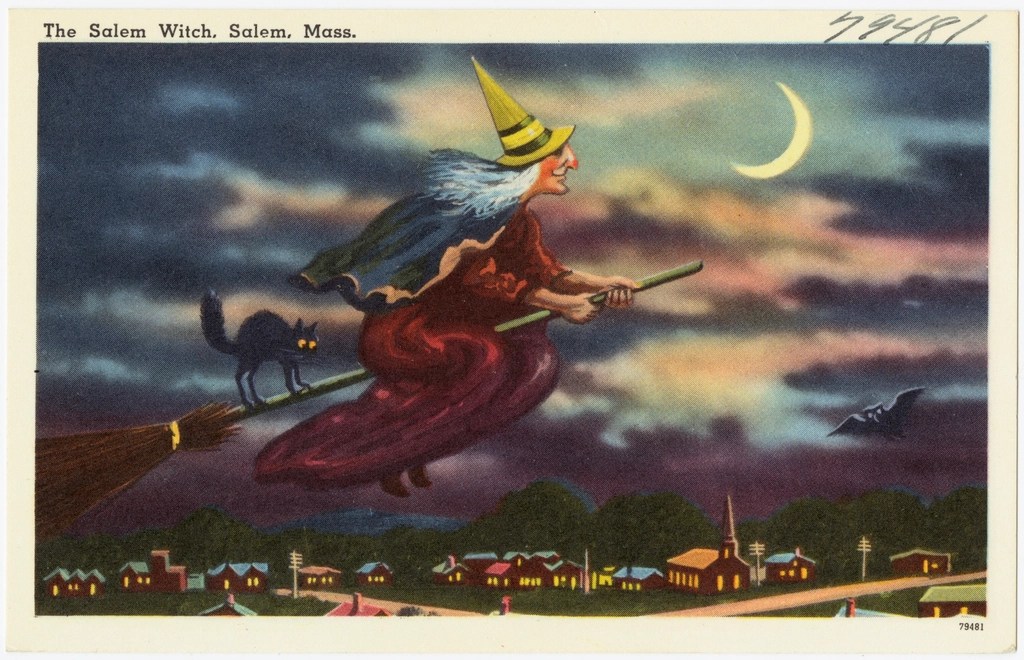
If you Google “witch,” you’ll see what you’d probably expect to see – pictures of green old wrinkly women menacingly threatening to curse you through the screen. This, the first definition of the word says, is part of the popular depiction of folks with this moniker. The second definition however, gets to the less literal meaning, “an ugly or unpleasant woman.” Note that Google hides this definition under a warning label that it’s “derogatory.”
Fun fact: the example sentence for the second definition is “he can marry the old witch for all I care.” This, to me, suggests that witches, like their beautiful and pleasant counterparts, are expected to aspire to heterosexual marriage. Ha.
The word ‘witch’ is one of many that is used to disparagingly refer to disagreeable women.
The word witch is one of many (and I mean like so so many) that is used to disparagingly refer to disagreeable women. In fact, often these words refer to not only disagreeable women but specifically ugly and old disagreeable women. Off the top of my head are words like crone, harpy, and hag – but don’t worry, there are so many more.
In fact, there are so many words to mean an ugly, unpleasant, old, or somehow otherwise difficult woman. I did a quick search to see what other words I could find in this category and some additional fun ones include beldam, targe, cow, harridan, shrew, grimalkin, and the classic, bitch. Seriously, bitch came up as a synonym for witch.
Like God damn. I can’t think of a single gendered word to describe a difficult man and yet I produced a non-exhaustive list of ten synonyms for an unpleasant woman in minutes. A friend of mine, an older woman, has told me for years that women become invisible if not openly hated as they age. I think we see her lived experience reflected pretty clearly in the English language.
In a society where young girls are fetishized and aging is punished, it tracks to have a tome of derogatory terms for older, difficult women.
As we use a language, we further mold it in our image. In a society where young girls are fetishized* and aging is punished, it tracks to have a tome of derogatory terms for older, difficult women. In short, girls and young women who maintain their youthful appearance and naivety are good; but women who visibly age and take no shit are punished both socially and linguistically.
As a lover of gender theory and English, I am constantly taking note of word choice when describing women versus men. Proponents of Donald Trump will all but hit you over the head with it when campaigning against Kamala Harris. Taylor Swift says outright that if she were a man, she would be praised for her business strategy rather than derided for being “calculated.” It’s two sides of a coin, with the less flattering side being reserved for women who go against the grain.
In today’s example, the witchification of women is reserved for those who break the unspoken law of eternal youth, beauty, and pleasantness.
What we say, the words we choose, and how we speak is important. Language is a tool to keep or break the status quo.
What we say, the words we choose, and how we speak is important. Language is a tool to keep or break the status quo. I implore you to think carefully about and choose wisely the things you say. For example, I will never refer to an adult woman as a “girl.” I will never discredit a woman for aging. I will never question a woman’s abilities based on if she’s “likable.”
You can use your voice to advocate for change without shouting in the streets or starting a feminist blog. You can choose to use words in your everyday conversations to establish that a woman’s appearance and age do not define her. If you need to describe a person as unpleasant, you can choose words that are not confined to women. Trust, there are plenty of gender-neutral words for unlikable people.
And for the love of God can anyone point to a word that exclusively refers to an ugly, old, unpleasant man?!
*You can see the fetishization of young girls clearly in the general preference and praise for youth including thinness and the absence of body hair both of which naturally fade with age. A deeper dive into this disturbing trend deserves its own blog post.
Like what you see? Share with friends and make sure to follow!
Read Next:



Something went wrong. Please refresh the page and/or try again.

 Girling
Leave a comment